Bladder & Bowel Dysfunction Treatment in Stoneham
Urgency that maps your day around bathrooms, straining that takes twenty minutes, and a body that never feels finished.
What causes bladder and bowel dysfunction?
You check for a bathroom before you commit to anything. You have gone through the fiber, the water, the stool softeners. You spend twenty minutes in there and still do not feel empty. Maybe there has been an accident you have never told anyone about. These are among the least discussed symptoms in medicine and among the most treatable, because emptying is not passive plumbing. It is a coordinated muscle task, and the muscle doing it is the pelvic floor, which relaxes to let things out and holds to keep them in. When that coordination goes wrong, so does everything downstream.

To empty, the pelvic floor has to let go while the bladder or rectum pushes. In a lot of people it does the opposite: it tightens at exactly the wrong moment. The result is a stream that starts and stops, a bowel movement that takes twenty minutes of effort, and a persistent sense that something is still in there. No amount of fiber fixes a coordination problem. This pattern is identifiable in an assessment and it is retrainable.
Hard stool means straining. Straining means holding your breath and bearing down, which drives pressure into a pelvic floor that is often already tight, and a tight floor makes the next one harder still. The loop also drives pelvic pain, hemorrhoids and, over years, downward pressure on the support around the pelvic organs. Breaking it usually takes three things together: how you sit, how you breathe, and getting the muscle to release.
Needing to go the moment you get home, waking two or three times a night, or planning routes around bathrooms. Urgency is a signalling problem: the bladder reports full before it is, or the pelvic floor is irritated enough to keep the alarm going. Then the habits pile on, because going just in case teaches the bladder to fire at smaller volumes. Urge calming and gradual retraining of the interval both work, and they work faster than people expect.
This is the symptom people carry longest without telling anyone, and it is far more common than the silence suggests. The anal sphincters and the surrounding pelvic floor do the holding, and they can be weakened by a birth injury, surgery, nerve changes or simply years of straining. Poor closure plus loose or incomplete stool is what produces an accident. It is a muscle strength and coordination problem, which means it is trainable, and it is completely ordinary to raise here.
Sitting upright with your feet flat keeps the rectum at an angle that resists emptying. Getting the knees above the hips opens it. Hovering over a public seat holds the pelvic floor half contracted so nothing empties properly, and pushing to hurry it up strains the tissue. Add rushing, ignoring the urge because you are in a meeting, and low fluids, and the mechanics stack against you. This is the fastest changing part of any plan.
A cesarean, hysterectomy, hernia repair, prostate surgery, bowel surgery or a significant tear all leave healing tissue and can change how the pelvic floor and abdominal wall work together. Scar restricts, nearby muscles guard around it, and the whole pressure system reorganizes around the restriction. It is also why symptoms sometimes surface long after everyone declared the recovery finished. Scar remodels with hands-on work and graded load, even years later.
How physical therapy in Stoneham helps.
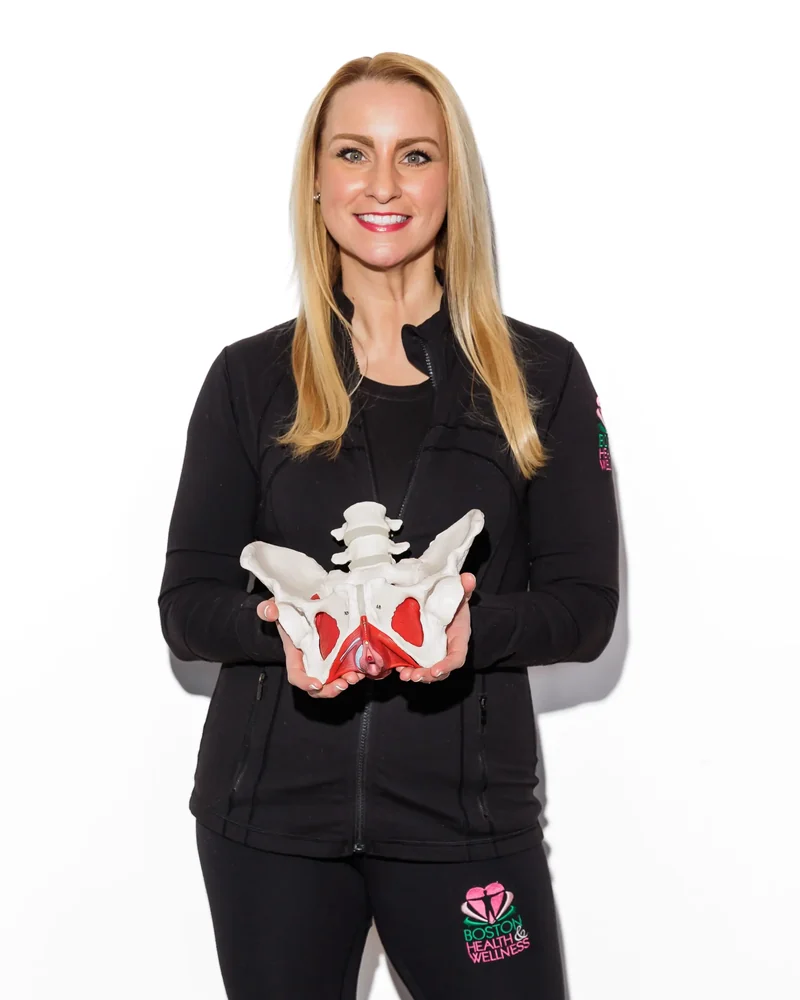
The first visit is a conversation in a private room, one on one, and yes, you will be asked direct questions about your bowels and bladder. That is ordinary clinical information here, and nothing about it is a spectacle. A pelvic floor assessment may include an internal exam, because that is the clearest way to see whether the muscle relaxes when it should, and it is optional. You control the pace, you can decline any part of it, and many plans begin with breathing, positioning and bowel or bladder retraining alone. Treatment then combines hands-on work through the abdomen, hips and pelvic floor, downtraining so the muscle can actually let go, and progressive strengthening for holding when you need to hold. If leaking, pain or heaviness travel with it, they get addressed in the same plan. Several of our licensed physical therapists are pelvic floor certified, including founder Dr. Stefanie DePaul, and Massachusetts is a direct access state, so no referral is needed.
What to expect from your recovery.
Evaluation
We take a full history of your symptoms, your fluids, your usual day and your bathroom pattern, then assess your abdomen, hips, breathing and pelvic floor, with an internal component only if you choose it. The goal is to work out whether the muscle cannot relax, cannot hold, or is simply mistimed. You leave knowing which one it is.
Hands-on plan
Manual therapy through the abdominal wall, hips and pelvic floor to release what is gripping, plus scar mobilization where surgery or a tear has left restriction. Alongside it, the practical work: toilet positioning, how to breathe out instead of bearing down, urge calming, and a schedule that retrains the bladder rather than reacting to it.
Progressive strengthening
Once the muscle can release on command, we train the other half of its job. Endurance and speed for holding, coordination with your breath and deep abdominals, then load through the hips and trunk so the system holds up during a lift, a run or a long day. Most people notice a change in the first few visits, and the plan is built around your goals.
Love coming here. I see Dr. Anna and feel like she treats me holistically instead of just my problem.
Pain rarely travels alone.

Back Pain & Sciatica
Nerve pain down the leg and a back that locks up. Both have a cause we can find.
Neck Pain
Stiffness, headaches and pain that radiates into the shoulder and arm.

Personal Training
Training built on your rehab, so the gains you made in PT keep going.
Ready when you are.
Saturday: 7:00am - 1:00pm | Sunday: Closed