Shoulder Pain Treatment in Stoneham
Reaching for the seatbelt, getting a shirt over your head, rolling onto that side at two in the morning: the smallest movements are the ones you now plan around.
What causes shoulder pain?
It has been weeks. It is not worse, exactly, but it is not going away either, and you have quietly stopped reaching for the top shelf. The shoulder is the most mobile joint in the body, which is another way of saying it depends almost entirely on muscle control to stay where it belongs. When the rotator cuff fatigues, when the shoulder blade stops gliding properly, or when the neck starts referring pain down the arm, all that mobility turns into irritation. Which one is happening in your shoulder changes the entire plan.

The rotator cuff is four small muscles whose job is to hold the ball of the shoulder centered in its socket while the bigger muscles move the arm. They get strained by repeated overhead work, or torn by a fall or a hard pull. The signature is pain reaching overhead, pain lifting a gallon of milk out to the side, and pain lying on that shoulder at night. Plenty of cuff injuries do well without surgery, because strength built around the tissue changes what the damaged part is asked to do.
There is a narrow space between the top of the arm bone and the bony roof above it, and the cuff tendons and bursa live inside it. If the cuff fatigues or the shoulder blade tips forward, the ball of the joint drifts upward and those tissues get compressed with every overhead reach. The pain has a distinct arc: fine at the bottom, sharp through the middle of the range, easier at the top. Restoring the mechanics that keep the ball centered is what opens that space back up.
Frozen shoulder is the capsule around the joint thickening and tightening down, and it behaves differently from every other shoulder problem. It usually starts with pain that outruns any injury you can remember, then progresses to stiffness in every direction, especially turning the arm outward. It often follows a stretch of not moving the shoulder, after surgery or another injury. It moves through phases over months, and hands-on work plus the right movement at the right stage makes those phases far more tolerable.
Your arm does not move alone. For every degree the arm lifts, the shoulder blade has to rotate and glide across the rib cage to keep the socket underneath it. When the muscles controlling the blade are weak, or the mid back is stiff, that rotation falls short and the joint runs out of room early. This is why so many shoulder problems get solved behind the shoulder rather than at it.
Two structures sit at the front and top of the shoulder and routinely get blamed for each other. The AC joint, where the collarbone meets the shoulder blade, hurts right on top and gets loud with reaching across the body or lying on that side. The biceps tendon runs through a groove at the front and hurts with lifting and pulling. Both respond to hands-on work and to correcting whatever overloaded them. Telling them apart is testing, not guessing.
Not all shoulder pain is a shoulder problem. An irritated nerve root in the neck can send aching, burning or weakness into the shoulder and upper arm while the joint itself tests clean. If your pain sits toward the top of the shoulder and the base of the neck, comes with tingling, or does not change much when the arm is moved, the neck is worth ruling in or out first. That distinction is part of every shoulder evaluation we do.
How physical therapy in Stoneham helps.
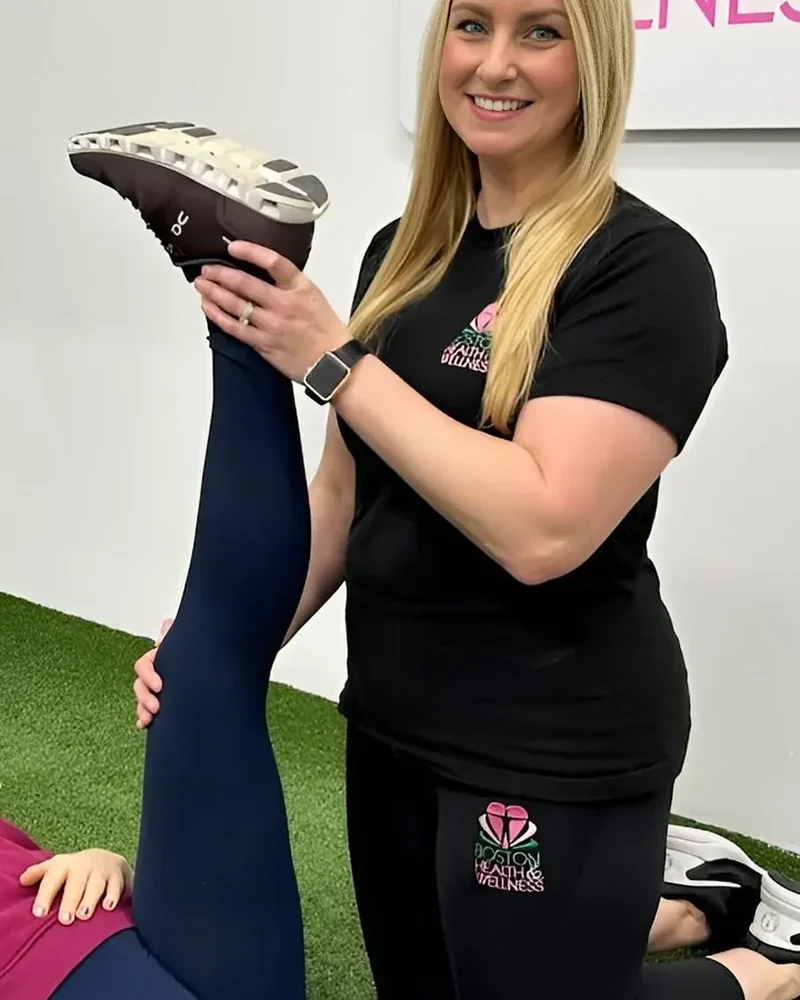
It starts with an assessment that separates the possibilities instead of guessing between them. A licensed physical therapist measures your range in every direction, tests the cuff muscle by muscle, watches how your shoulder blade moves when you lift, screens your neck, and finds out which motions in your day set it off. Then the hands-on work. Joint mobilization restores the glide the shoulder has lost, and soft tissue work through the cuff, chest and mid back releases what has tightened around the problem, which is usually what gives range back first. Then we load it, because range without strength does not last. Progressive rotator cuff and shoulder blade strengthening, taken from light and controlled to overhead and loaded, is what lets you reach, lift and sleep on that side again. Every visit is one on one with the same therapist, in Stoneham or Wakefield, and most plans do not require a referral to start.
What to expect from your recovery.
Evaluation
We measure range, test the cuff muscle by muscle, watch your shoulder blade through a full lift, and screen the neck to rule it in or out. We also ask what actually provokes it, since a shoulder that hurts overhead needs a different plan from a shoulder that hurts at night. You leave the first visit knowing what we found.
Hands-on plan
The next phase is about giving you room. Joint mobilization for the glide the shoulder has lost, soft tissue work through the cuff, the chest and the mid back, and needling or instrument-assisted work where the tissue will not release on its own. Range usually returns before strength does, and it is a good sign when it does.
Progressive strengthening
Then we load the shoulder deliberately, from light rotator cuff work at your side up to the overhead and reaching demands your job or your sport actually asks for. Shoulder blade strength gets built alongside it. This is the slower phase, and the one that decides whether the pain comes back next season.
I'm extremely happy with the program at Boston Health! Elyse has been very patient with me and has steered me through a particularly significant shoulder injury rehab. Can't say enough about the care!
Pain rarely travels alone.


Ready when you are.
Saturday: 7:00am - 1:00pm | Sunday: Closed