Neck Pain Treatment in Stoneham
Checking your blind spot, getting through an afternoon of screens, finding one position at night that does not make it worse: your neck is running your whole day.
What causes neck pain?
You have been told to sit up straighter. You have been told it is stress. Neither explained why turning your head to back out of the driveway still hurts. Your neck carries your head through a stack of small joints, discs and muscles that has to stay mobile and stable at once, all day. When one part of that stack stops moving well, the rest works harder to cover for it, and the symptoms spread: stiffness, a headache creeping up the back of the skull, an ache between the shoulder blades, tingling down the arm. Naming the real driver is where relief starts.
Your head is heavy, and the further forward it drifts, the harder the muscles at the back of your neck work to hold it up. A laptop on a low desk, a phone at chest height, a monitor set too far away: each parks you there for hours. Those muscles are not injured. They are working a shift that never ends, so they get tight, sore and eventually painful. The fix is rarely one perfect posture. It is enough strength, and enough position changes, that nothing holds still all day.
Between the vertebrae in your neck sit discs and small facet joints that let you turn, tip and nod. Over the years the discs lose height and the joints take on more load, leaving the neck stiff in one direction and sore in another. If a disc or a bony change narrows the space where a nerve exits, symptoms can travel into the shoulder, arm or hand. Changes like these appear on imaging in plenty of people with no pain at all, so what matters is how the neck moves and how well it is supported.
A rear-end collision loads the neck faster than the muscles can brace. Tissue strains in the moment, then the region tightens to protect itself, which is why the worst stiffness often arrives a day or two later rather than at the scene. Headache, jaw tension and pain across the upper back are common companions, and recovery tends to go better when gentle motion starts early. If your neck pain began in a crash, see our auto accident injuries page.
When something in the neck hurts, the surrounding muscles clamp down to limit the movement that caused it. That guarding is useful for a few days and counterproductive after that. The upper trapezius, the levator scapulae and the small muscles at the base of the skull get short and irritable, and firm bands inside them refer pain in predictable patterns: behind the ear, across the shoulder, into the shoulder blade. Releasing that tone gives you room to move, but it only holds if the strength underneath gets rebuilt.
Pain between the shoulder blades or down the arm frequently starts in the neck. An irritated nerve root at the cervical spine can send aching, burning, pins and needles or weakness well away from its source, which is why treating the shoulder alone often goes nowhere. Part of a neck evaluation is sorting out what belongs to the neck and what belongs to the shoulder itself. Where both are involved, we treat both.
A large share of stubborn headaches are driven by the upper neck. When the top segments of the cervical spine stiffen, or the muscles at the base of the skull stay tight, they refer pain into the temple, forehead and behind the eye, so it presents as a headache while the source sits below it. The giveaway is that neck position changes the headache. Our headaches page goes further.
How physical therapy in Stoneham helps.
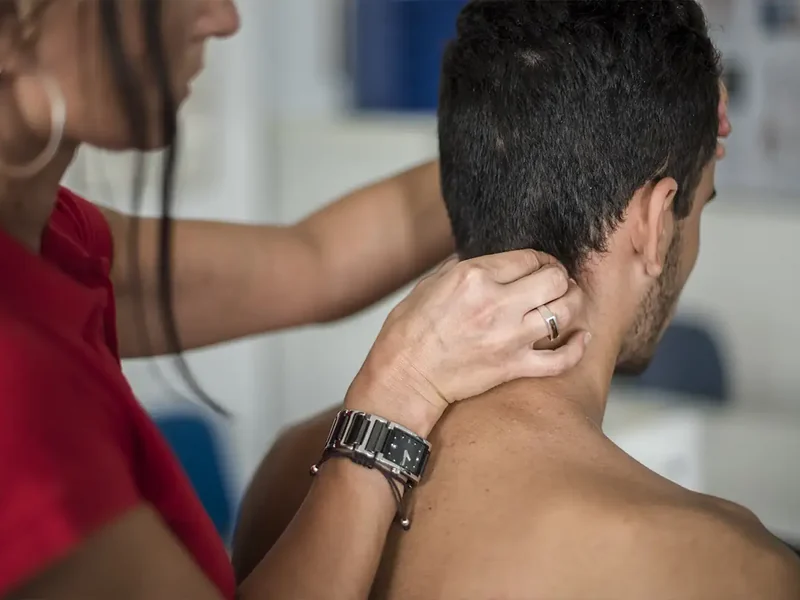
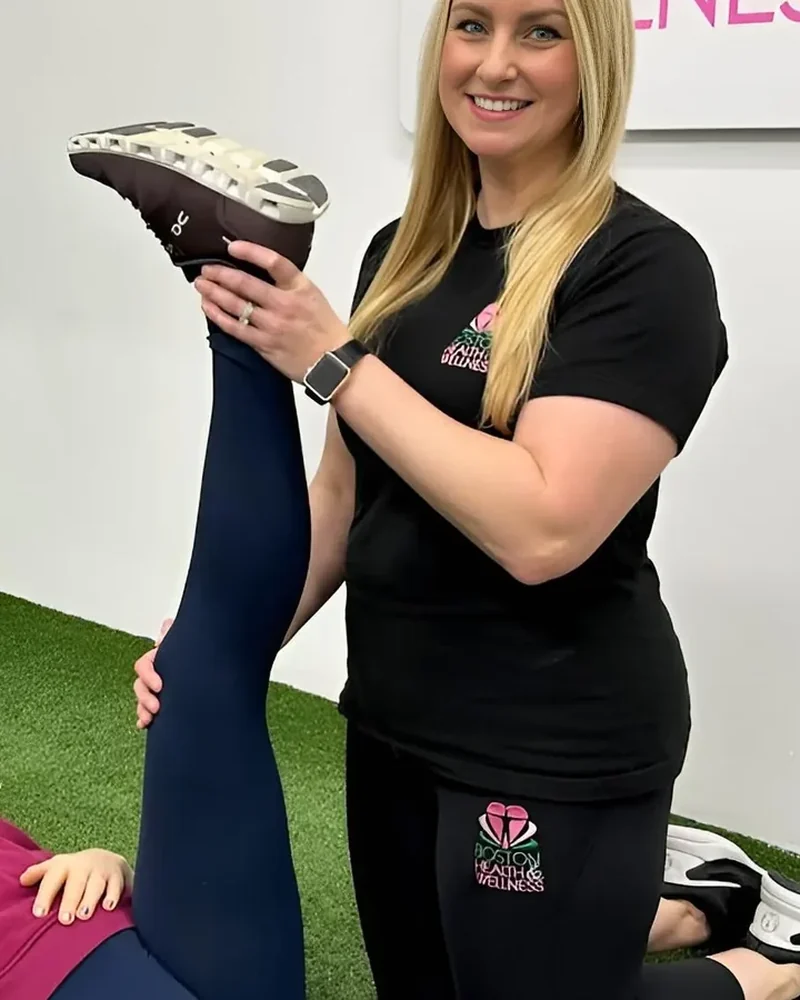
It starts with an assessment, and for a neck that means more than asking where it hurts. A licensed physical therapist tests each level of your cervical spine for how it moves, screens the nerves running into your arm, checks what your shoulder blades and mid back contribute, and asks about your desk, your car and how you sleep. Then the hands-on work. Joint mobilization restores motion at the segments that have lost it, and soft tissue work quiets the trapezius, the levator and the muscles at the base of the skull, so turning your head stops being a negotiation. Manual therapy buys back the range. Loading is what keeps it, so from there we build deep neck flexor endurance and strength across the mid back and shoulder blades. You work one on one with the same therapist in Stoneham or Wakefield, and because Massachusetts is a direct access state, most people start without a referral.
What to expect from your recovery.
Evaluation
We test how each level of your neck moves, screen the nerves running into your arm, and check the mid back and shoulder blades that support everything above them. We ask what your day looks like, because a neck that hurts every afternoon is telling you something different from one that hurts on waking.
Hands-on plan
Then we work directly on what is stiff and what is guarding. Joint mobilization at the restricted segments, soft tissue work through the upper trapezius and the base of the skull, and dry needling where the muscle tone will not let go. The aim is simple: enough comfortable range that movement stops being something you brace for.
Progressive strengthening
Range that is not supported gets lost again, so this phase builds the support. Deep neck flexor endurance, mid back and shoulder blade strength, and gradual loading of the positions that used to provoke you. Most people feel a change early on, and this is the work that decides whether it holds.
The best clinic, with the best professionals, is right here. The professionals here work with love and dedication. It's as if we were all long-time friends...
Pain rarely travels alone.

Shoulder Pain
Reaching, lifting and sleeping should not hurt. We find out why they do.

Hip & Knee Pain
Stairs, squats and long walks get their difficulty back.

Blood Flow Restriction Training
Build real strength with light loads, ideal when heavy lifting is off the table.
Ready when you are.
Saturday: 7:00am - 1:00pm | Sunday: Closed