Blood Flow Restriction Training in Stoneham
When the joint cannot take heavy weight yet, the strength you are losing every week is the real problem, and closing that gap is exactly what blood flow restriction training was built to do.
What is blood flow restriction training?
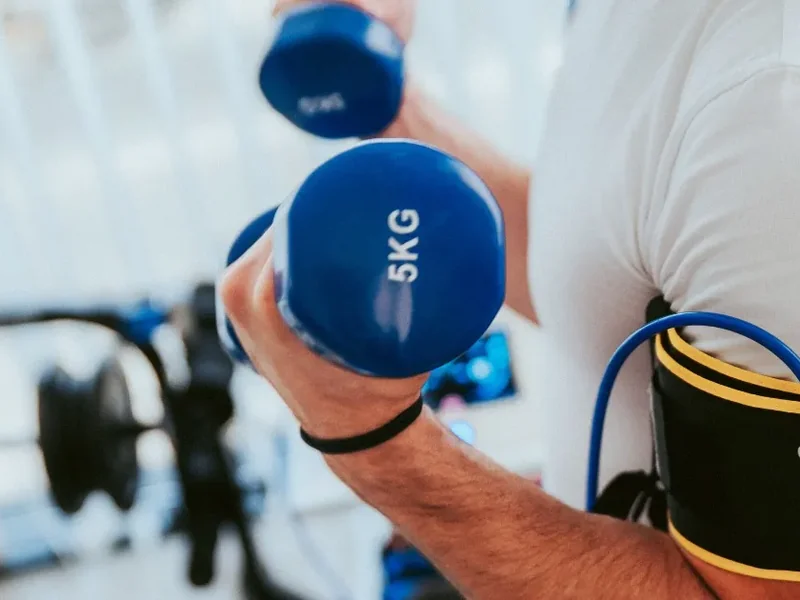
Blood flow restriction training is a way to build strength using light weight. A calibrated cuff is placed high on the arm or thigh and inflated to a set pressure. That pressure lets arterial blood keep flowing into the limb while limiting the venous return out of it, so the working muscle trains in a low oxygen environment. Under those conditions a light load feels like a heavy one to the muscle. The body recruits the larger, fast fatiguing fibers it would normally save for heavy lifting, and it releases the same signals for growth and repair that heavy training produces. The practical result is that a joint which cannot yet tolerate a loaded squat can still be trained hard enough to hold on to muscle. None of that pressure is guesswork. Your licensed physical therapist measures the pressure it takes to occlude your limb, works at a portion of that measurement, watches how the limb responds and adjusts. Cuff placement, load, repetitions and rest are all part of the prescription, which is why this belongs in a clinic rather than in a home gym with a pair of straps.
Who this genuinely helps is anyone stuck in the gap between an injured joint and a barbell. After knee surgery the quad shuts down and shrinks fast, and every week it stays quiet is a week you will spend rebuilding later. Blood flow restriction lets us start that rebuilding early, at loads a healing joint can handle. Athletes use it from the other direction, adding training volume without adding joint stress during a heavy week. Older patients use it when arthritis makes heavy loading miserable and strength is exactly what the joint needs. In every case it is one tool inside a full plan, never the plan itself. We run it at both our Stoneham and Wakefield offices, and you can book directly, because Massachusetts is a direct access state and most plans do not require a referral.
Who it's for.
Blood flow restriction is for people who need strength but cannot get at it the usual way yet. Three situations we see constantly in Stoneham and Wakefield.
Early after an ACL repair or knee replacement
Your surgeon has limited how much weight the leg can take, and meanwhile your quad is visibly smaller than the other one. Training that muscle with a light load and a cuff protects the strength you still have and starts adding back what you lost, inside the limits your surgeon set. You reach the heavy phase of rehab with a leg that is ready for it.
An athlete in season who cannot spend the joint
You need the training effect without another heavy session grinding on a cranky shoulder or knee. Blood flow restriction gives us a way to accumulate real work at a fraction of the weight, so you keep building on the days your body cannot absorb a maximal effort. Your therapist fits it around your competition schedule instead of fighting it.
Arthritic joints that punish heavy lifting
Loading the knee or hip the traditional way leaves you sore for days, so you stopped, and the joint has grown weaker for it. Light loads under cuff pressure let you train the muscles that support the joint without the pounding that made you quit in the first place. Strong muscle around an arthritic joint is one of the most dependable things you can build.
What to expect in a session.
Nothing about a blood flow restriction session is improvised. Here is how it runs, from the cuff going on to the cuff coming off.
Measuring and fitting the cuff
Before anything gets trained, your therapist measures your limb occlusion pressure, which is the pressure at which blood flow into that limb stops. Your working pressure is set as a portion of that measurement, individual to you and to the limb being trained. The cuff is then fitted high on the arm or thigh, snug and even, and checked before a single repetition.
The working sets
You lift a light weight for a long set, rest briefly, and repeat. It burns. By the later sets the muscle feels far heavier than the weight can explain, which is the entire point. Your therapist stays with you the whole time, watching your form and the feel and color of the limb, and the cuff is inflated only for the working period, not for the whole visit.
Cuff off, then the rest of your plan
The cuff comes off, the limb flushes, and the heaviness fades quickly. Then you finish the session with everything else your case needs: hands-on work, motion, balance, whatever the plan calls for that day. Blood flow restriction is one piece of the visit. It does not replace the strengthening and movement work that makes the result stick.
Blood flow restriction is not right for everyone. Talk to your therapist and your physician before you start if you have a history of blood clots or a clotting disorder, vascular disease, uncontrolled high blood pressure, a heart or kidney condition, an open wound or active infection in the limb, or if you are pregnant. During a set, a strong burn and heavy fatigue in the muscle are expected. Numbness, sharp pain, chest discomfort, dizziness or a limb that changes color and stays that way are not. Say something the moment it happens and the cuff comes off. Your therapist screens for all of this before your first session and keeps checking as you go.
Amazing clinic, with awesome staff that helped me through my post-op care! Would highly recommend especially for pelvic health physical therapy
Where to go next.

Ready when you are.
Saturday: 7:00am - 1:00pm | Sunday: Closed