Pelvic Organ Prolapse Treatment in Stoneham
A heaviness or dragging feeling low in the pelvis by the end of the day, or a bulge you found and have told nobody about.
What causes pelvic organ prolapse?
You noticed it in the shower, or at four in the afternoon, or the first time you went back to running. Heaviness. A dragging feeling. The sense that something is sitting lower than it should. Then you searched it at midnight and the first word you read was surgery. Prolapse means the support around the bladder, uterus or rectum has stretched, so those organs sit lower than they used to. It is common, it is not a verdict on how you carried a baby or lifted a box, and conservative care is the standard first step rather than the consolation prize.

Carrying a pregnancy loads the pelvic floor for months, and a vaginal delivery stretches the muscles, fascia and ligaments that hold the pelvic organs in place. A long pushing stage, an assisted delivery or a significant tear increases that load. Those tissues are designed to recover, but recovery is not automatic and it is not finished at the six week check. Symptoms that appear months or even years later usually trace back to support that never got rebuilt.
Every time you strain on the toilet, cough hard or hold your breath and bear down to lift, pressure drives downward through the pelvis. One instance is nothing. Chronic constipation, a long term cough or a job that has you lifting all day is a repeated load on the same tissue, year after year. This is one of the most changeable causes on this list, because how you breathe, brace and empty your bowels can be retrained.
Support depends on muscles that can generate force at the right moment. Weak muscles cannot. Less obviously, muscles held permanently tight cannot either, because a muscle already at the end of its range has nothing left to contribute when you cough or lift. That is why kegels alone sometimes make symptoms worse, and why an assessment matters before anyone hands you an exercise. The plan for a tight pelvic floor looks nothing like the plan for a weak one.
Estrogen influences the quality of the connective tissue and the tissue lining the vaginal wall. As levels fall through perimenopause and after, that tissue tends to become thinner and less elastic, which changes how much support it offers. This is a real, physiological reason symptoms often surface or worsen in midlife rather than right after childbirth. It is also a question worth raising with your physician, while the muscular side of the picture is what physical therapy addresses.
Some people are simply built with more elastic connective tissue. If you are generally hypermobile, or prolapse and hernias run in your family, the supporting structures may stretch more readily under the same load. You did not cause it and you cannot change it. What you can change is the muscular support around it, the pressure you generate through the day, and how well the system coordinates when you are actually loading it.
The abdomen behaves like a pressurized canister: diaphragm on top, deep abdominals around, pelvic floor at the base. If you hold your breath and push out through the belly every time you lift, that pressure has to escape somewhere, and downward is the path of least resistance. Retraining the timing between breath, deep abdominals and pelvic floor is often what turns heaviness at 4pm into an ordinary afternoon.
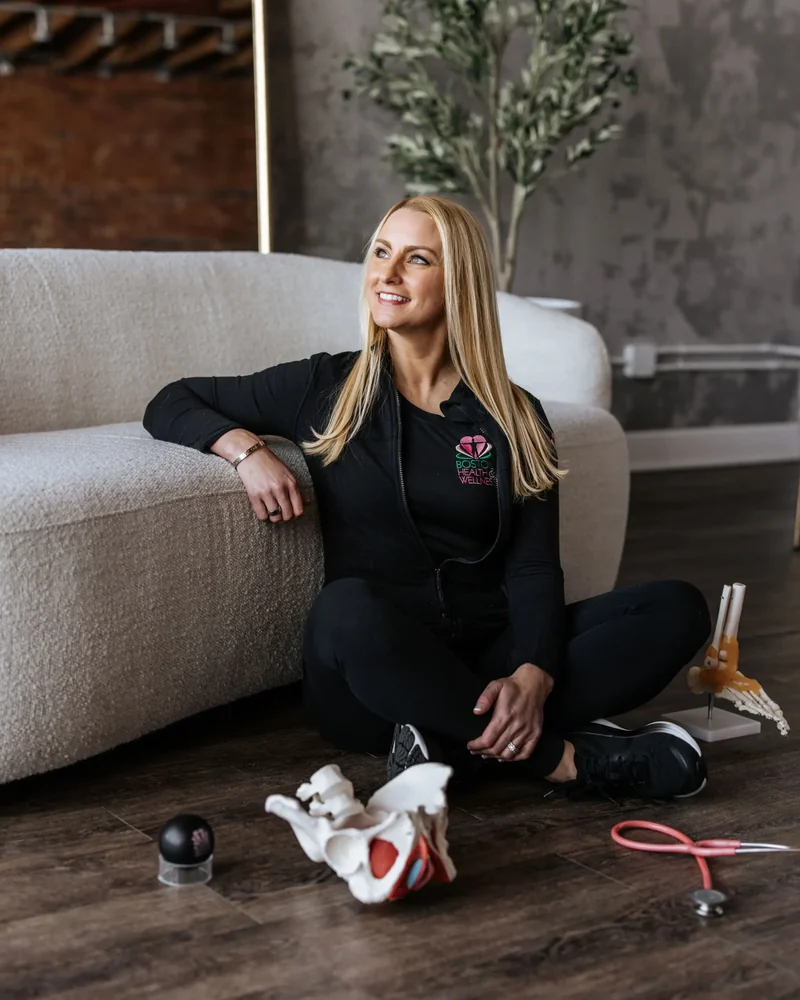
How physical therapy in Stoneham helps.
Nothing gets sprung on you. The evaluation starts as a conversation in a private room: what you feel, when it is worst, what you have stopped doing because of it. A pelvic floor assessment may include an internal exam, since that is the clearest way to judge how the muscles generate and time force, and it is entirely your call. You can decline it, pause it, or start with external work only. From there your therapist builds strength where support is missing, releases what is gripping, and retrains the pressure system so lifting, coughing and standing all day stop pushing downward. If leaking or constipation come with the heaviness, they get treated together. Several of our licensed physical therapists are pelvic floor certified, including founder Dr. Stefanie DePaul. Massachusetts is a direct access state, so you can book without a referral.
What to expect from your recovery.
Evaluation
A conversation first: what you feel, when it started, what makes it heavier, what you have quit doing. Then an assessment of your hips, trunk, breathing and pelvic floor strength and timing, internal only with your say so. You leave understanding which part of the support system is not doing its job.
Hands-on plan
Manual therapy where tissue is restricted or gripping, including scar from a cesarean or a tear, because a tight pelvic floor cannot support anything. Alongside it you get the practical layer: how to empty your bowels without straining, how to exhale through a lift, and positions that unload the pelvis when symptoms build late in the day.
Progressive strengthening
Then we build load tolerance. Pelvic floor and deep abdominal coordination first, then glutes and trunk, then real tasks: groceries, stairs, a barbell, a shift on your feet. Symptoms often ease well before anything visible changes, because comfort tracks how well the system handles pressure. The plan is built around what you want to get back to.
I feel incredibly lucky to be a patient at Boston Health & Wellness Physical Therapy - this place is truly a gem!
Pain rarely travels alone.



Ready when you are.
Saturday: 7:00am - 1:00pm | Sunday: Closed